Bonfire Space: Lights That Cannot Reach Each Other
Imagine an endless night sky scattered with bonfires. Each one burns, but its light never reaches another. I call this kind of high-dimensional representation space bonfire space.
A shared map in low dimensions
Start with three bonfires on a flat, two-dimensional map. Measure their positions from the same origin: A is one step east, B is one step north, and C is one step east and one step north. In coordinates, A = (1, 0), B = (0, 1), and C = (1, 1), so C = A + B.
Two independent directions cover this whole map. Once a third fire’s coordinates are given, you can describe how to reach it using those same directions. Knowing A and B alone does not tell you where an unknown C is; they give you a shared language for locating it.
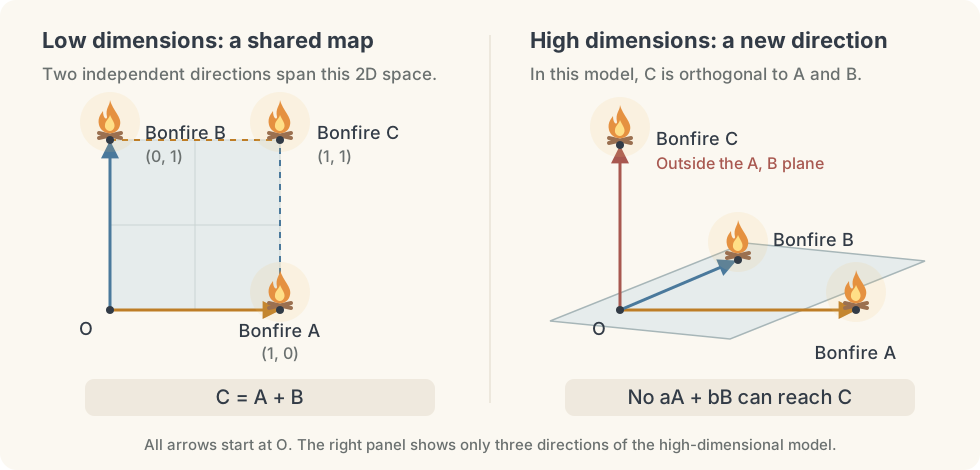
Independent directions in bonfire space
A bonfire’s “location” is a direction in representation space, rather than a place you can mark with three ordinary spatial coordinates. A high-dimensional space has room for many independent directions. Each bonfire shines along its own.
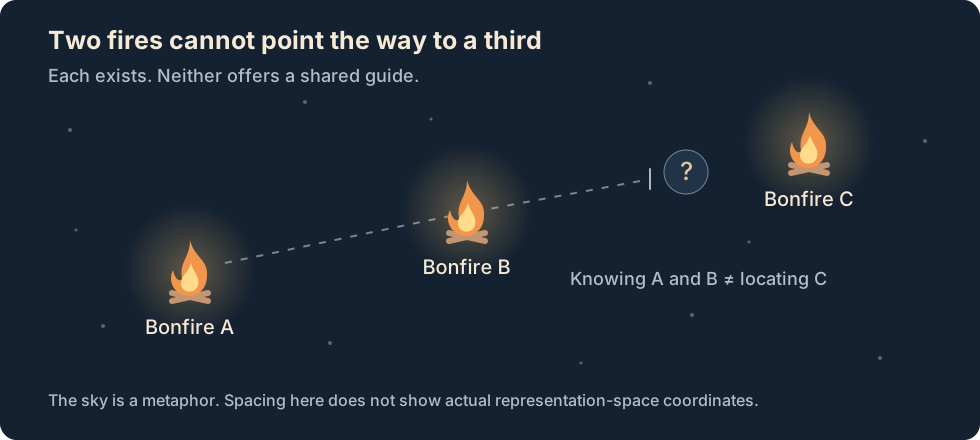
Here, “far apart” means orthogonal: one bonfire’s direction has no projection onto another’s. They share no direction that could serve as a guide from one to the other.
Try to read one through the other by taking their inner product, and the result is zero. This is the “nothingness” of bonfire space: no shared signal. Even combining the two directions leaves you within the space they span. You cannot reach a third bonfire whose direction is orthogonal to both.
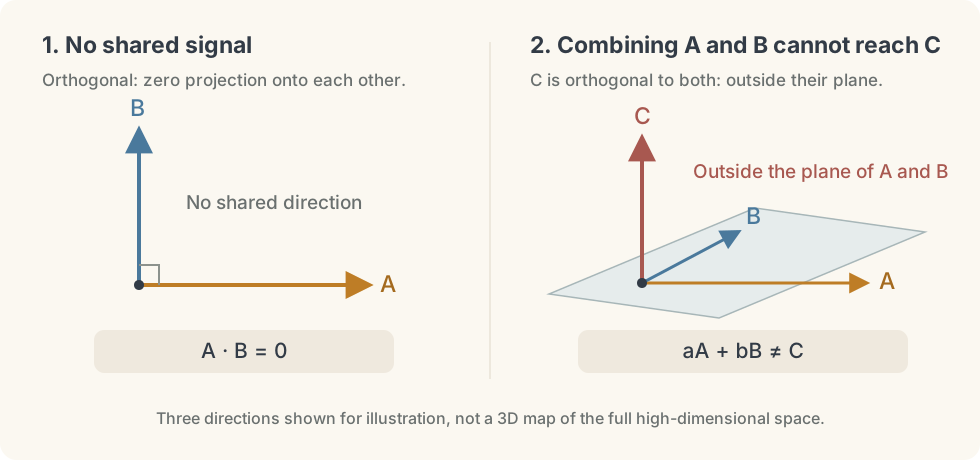
The difference is that two independent directions span the entire 2D map, while a third bonfire in this model lies beyond the first two directions. High dimensionality makes room for many such directions; mutual orthogonality is the assumption that keeps the fires separate.
Every bonfire burns. None gives directions to the others.